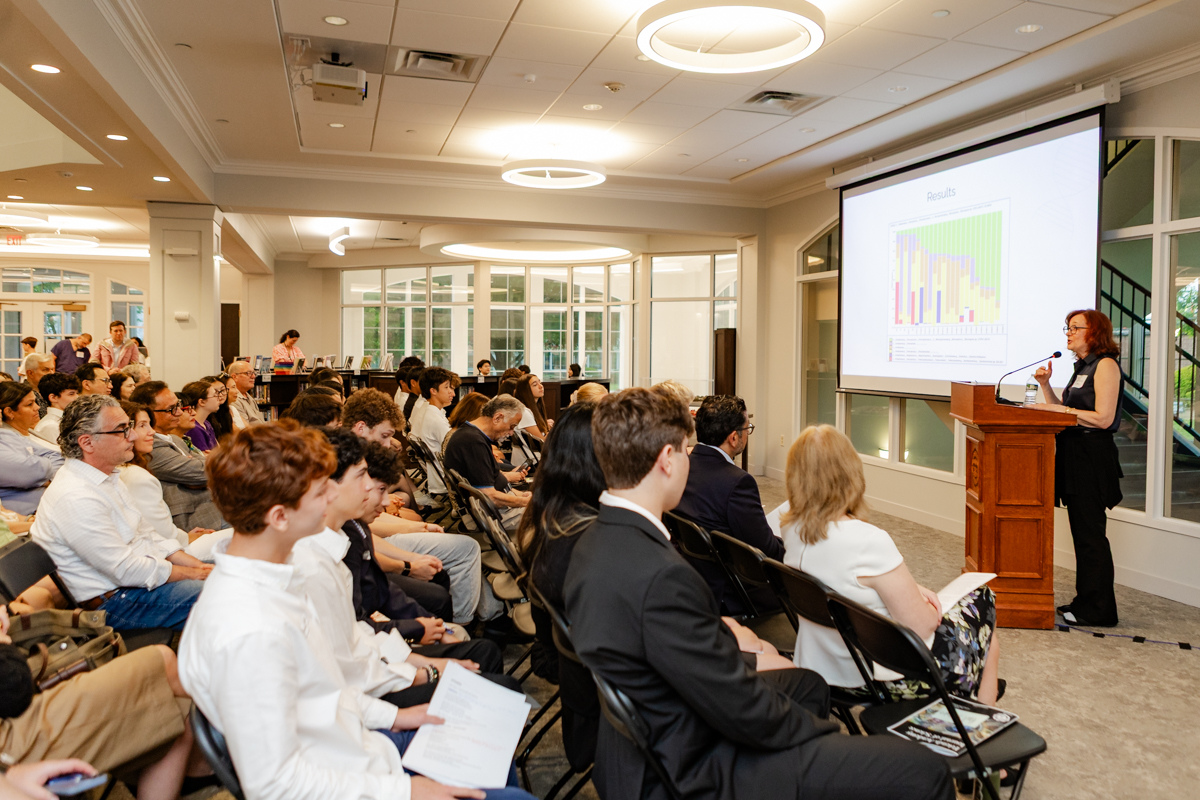
Friends Academy held its inaugural Science Research Symposium inside the Kumar Wang Library in late May, bringing together more than 120 people from the school community and showcasing students’ high-level research projects.
The evening featured keynote presentations, poster Q&A sessions, and speeches from teachers that highlighted major initiatives among the school’s science offerings: new Independent Science Research classes, and the school’s fourth year of DNA Barcoding Research classes conducted in partnership with the Cold Spring Harbor Laboratory’s DNA Learning Center.
The new Science Research Program gives Middle and Upper School students opportunities to go far beyond the scope of normal coursework. Over the past year, they dug into topics as varied as plants, bacteria, viruses, agricultural hormones, the vagus nerve, feeding tubes, tropical storms, tap water samples, hydraulic systems, meta resonators, and more.
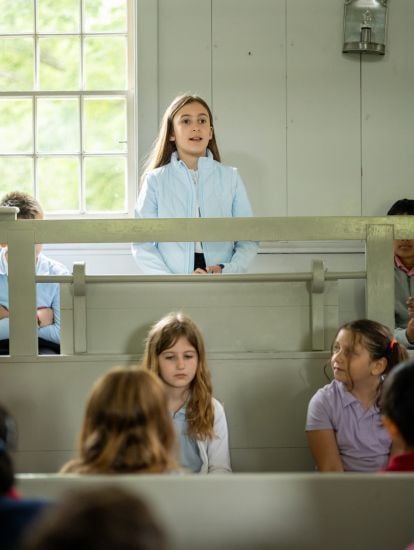
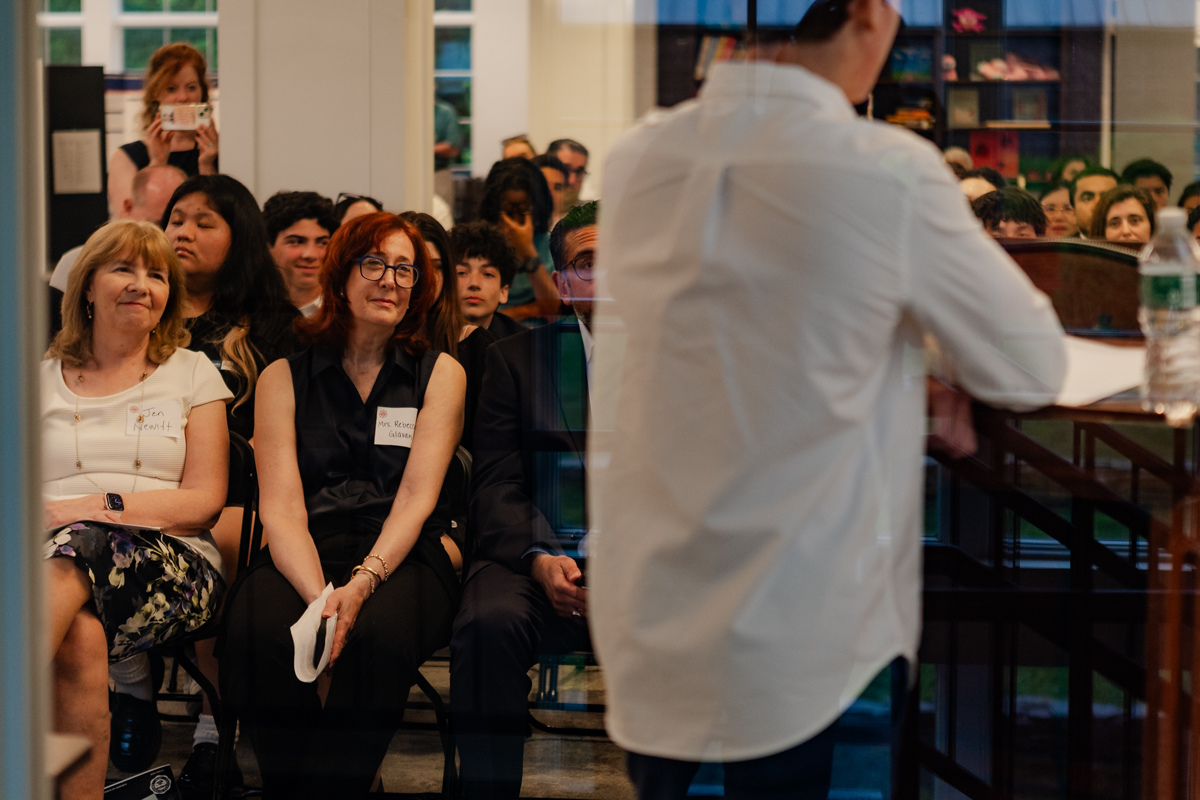
“Research was more than a destination for these students. It became a profound and life-changing journey,” said Mrs. Rebecca Glavan (pictured above), a Middle and Upper School Science teacher who leads the Science Research Program. “These students didn’t just learn scientific concepts — they mastered tangible tools, managed highly complex systems, and applied high-level critical judgment to unpredictable data. They asked big questions in the hopes of making this world a better place, only to realize that answering one question usually reveals the next.”
Mrs. Jen Newitt, Chair of the Science Department and an Assistant Principal in the Upper School, spoke about the DNA Barcoding class, which exposes students to collection, extraction, and testing methodologies so they can explore important questions about animal species and habitat biodiversity. Twenty students presented their research at the Barcode Long Island Symposium at the Cold Spring Harbor Laboratory and were commended by the Director of the DNA Learning Center for their outstanding results and poster presentations.
“Sometimes our students identify a DNA sequence that nobody else has identified before,” she told attendees. “We love that aspect of citizen science. At its core, scientific research is advancing human understanding — and the students in this course are advancing our understanding of what life exists on Long Island.”
In many ways, it was a banner year for scientific exploration at Friends Academy.
The school opened its new science center on the ground floor of the library; it houses a physics lab, robotics lab, makerspace, and science lab/classroom. The former physics lab in Frost Hall was also transformed in consultation with the DNA Learning Center into a state-of-the-art research lab.
In its first trip to the National Science Bowl Regional Competition, the Friends Academy team placed fourth among all schools on Long Island.
In its first trip to the Long Island Environthon — a natural resource conservation competition for high school students that incorporates problem-solving, teambuilding, and leadership challenges — Friends Academy won the event.
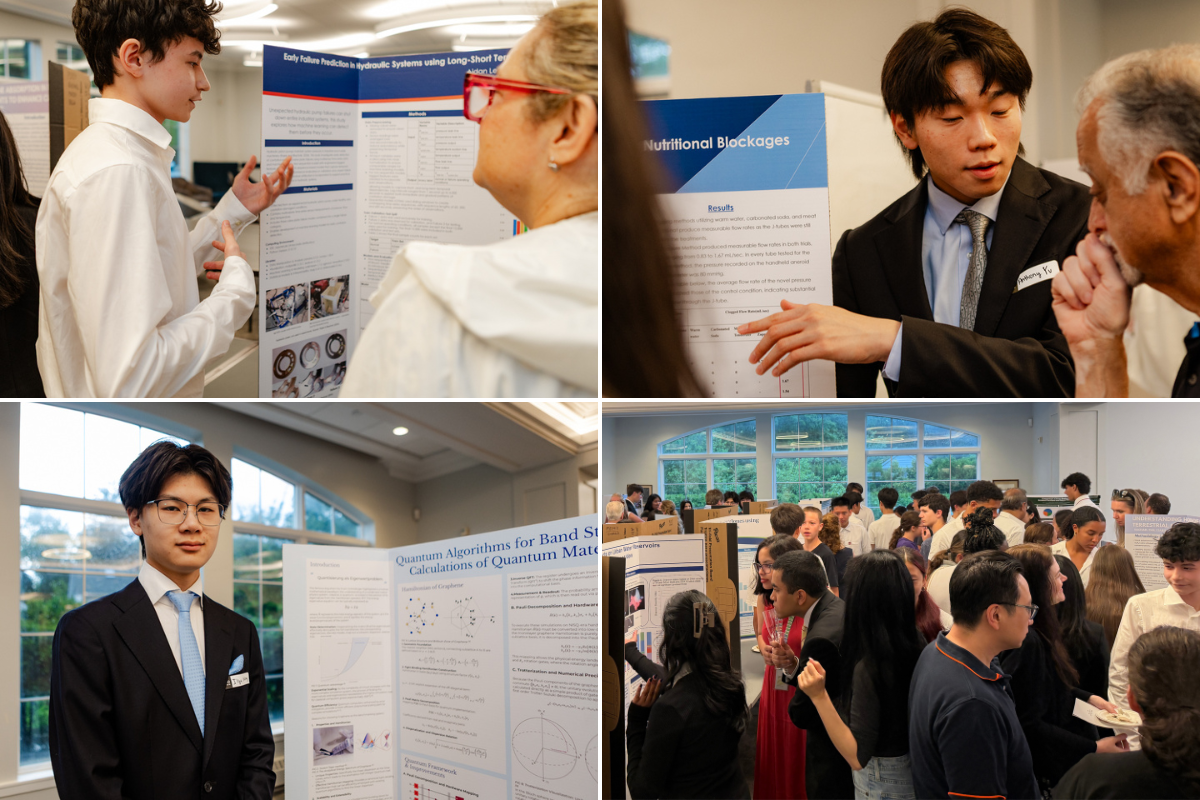
Across divisions of Friends Academy, many student scientists received recognition in research competitions and publications.
Notably, senior Julang Wang was one of 300 scholars worldwide to be named as a semifinalist in the prestigious Regeneron Science Talent Search 2026. His groundbreaking work, “Localized Metaresonators for Mid-Wave Infrared Spatial Light Modulators,” was selected from more than 2,600 projects entered by students at 826 high schools across 46 states, Washington, D.C., the Northern Mariana Islands, Puerto Rico, and 16 countries, including China. (To coincide with Julang’s award, Mrs. Glavan received a Regeneron Teacher of Merit Award.)
Juniors Stefan Pappas, Meiqi Ma, and Isabella Panossian presented their Advanced Metabarcoding Research project at the Long Island Natural History Conference at Stony Brook University to an audience of predominantly university-level researchers about how metabarcoding can supplement more traditional methods used by naturalists. Stefan was also one of roughly 400 high school students in the country to earn a qualifying score on the F=ma exam, a 75-minute, 25-question (named after Newton’s Second Law of Motion) that serves as the preliminary round in the selection process for the U.S. team that competes in the annual International Physics Olympiad.
Sophomore Sarah Khan had her research with the Feinstein Institute published in the University of Pennsylvania’s Platform for Data Management, Pennsieve Discover. Her work focused on coding and stitching microCT scans of a cadaver vagus nerve to form a unified, virtual version of the nerve for researchers to study. She placed third at the Long Island Science Engineering Fair for her work.
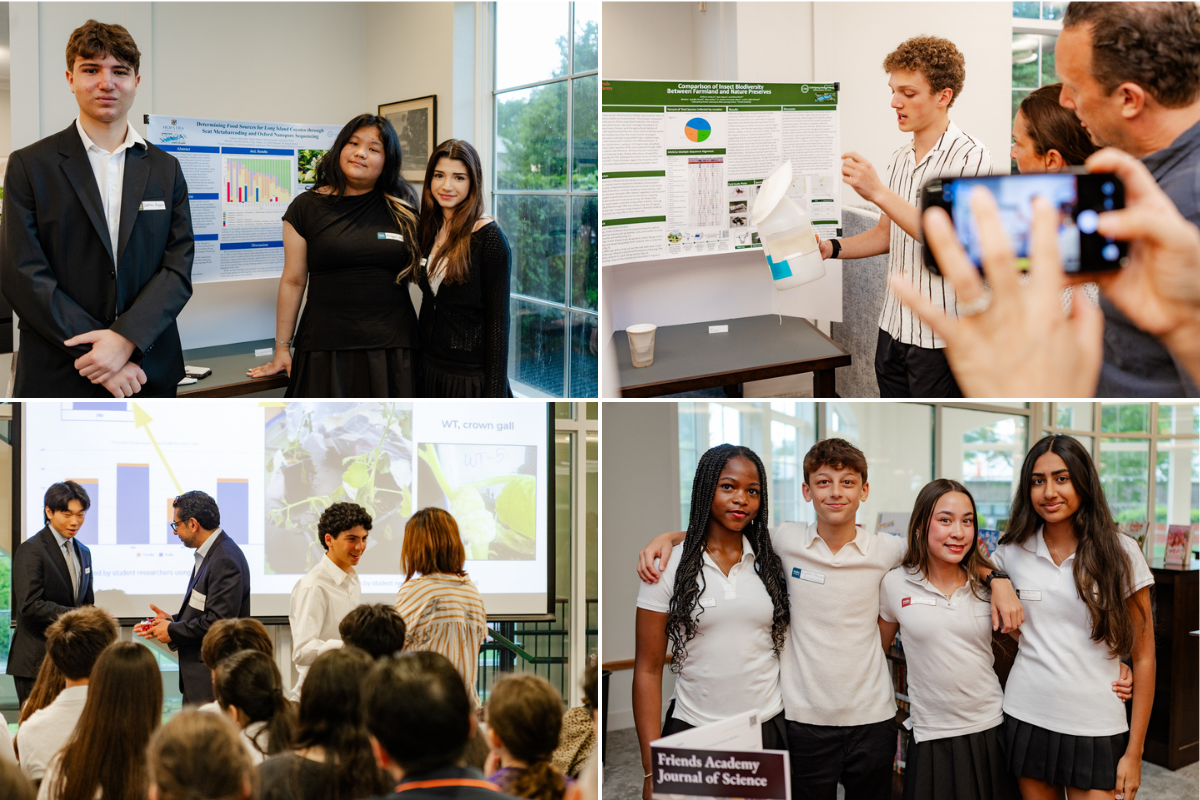
More than 20 Friends Academy students participated in the 2026 Long Island Science Engineering Fair (LISEF) and presented projects across an array of specialized areas, including plant sciences, energy, physics, biology, and computer sciences.
Five projects from Friends — worked on by seven Upper School students and three Middle School students — received honors across all levels of the LISEF competition (full list of awards).
In the highly selective second round of the varsity division, juniors Aleena Zaidi and Anthony Yu earned honorable mention for their work, “Improving Enteral Tube Care: Testing Methods to Clear Nutritional Formula Blockages Against a Novel Approach.”
Aleena and Anthony were guided in their work by Aleena’s father, Dr. Raza Zaidi, a surgical oncologist at Long Island Jewish Hospital, who spoke during the school’s Science Research Symposium.
He detailed how Aleena and Anthony had the chance to visit hospital floors and speak with doctors, nurses, and patients to understand the a problem. When it came to finding a solution, Dr. Zaidi said the medical field “had some ideas but never really had the ingenuity to get somebody to actually put the research behind it. That’s where Anthony and Aleena stepped in — and it’s a big deal because when patients aren’t able to eat, this is the means by which they get nutrition to recover from surgeries.”
Sometimes the experiments at Friends Academy are smaller in scope but still challenging.
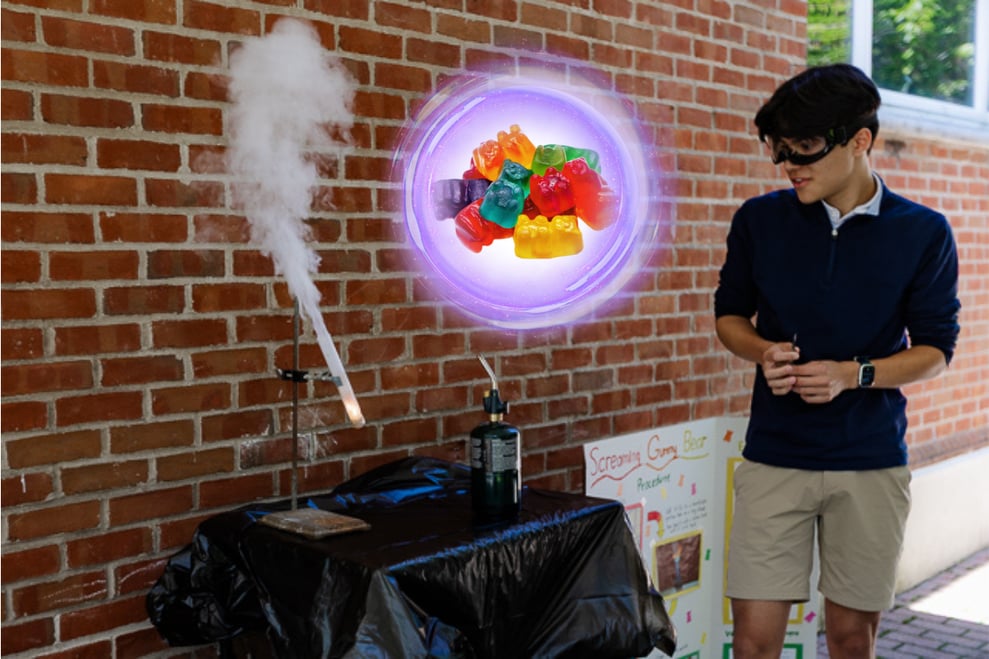
During the annual AP Chemistry Expo, Upper School students conduct experiments such as “The Screaming Gummy Bear” for Lower School students. The hardest part is finding ways to simplify complex topics for first, second, third, and fourth graders. “In order to do that, you have to have a really deep understanding of the chemistry,” says AP Chem teacher Ms. Sara Baldvins. “We also want to end the school year with a highlight and remind ourselves how exciting and thrilling science can be.”
Excitement from all scientific disciplines continues to build school-wide momentum.
Twenty students were enrolled in the Independent Science Research Program this school year. For next year, that number has already climbed to 61.
Overall, interest in both programs — Independent Science Research and DNA Barcoding — will more than double, from 36 this year to 82 next year.
“The desire for independent scientific inquiry at Friends Academy is skyrocketing,” Mrs. Glavan says. “To my students, thank you for your curiosity, your passion, and your stubborn refusal to never give up. You are living our Quaker testimonies of integrity, stewardship, and continuing revelation every time you step into a lab.”
Photography by Alvin Caal / Friends Academy
Download Premium
Lorem ipsum dolor sit amet, consectetur adipiscing elit, sed do eiusmod tempor incididunt ut labore et dolore magna aliqua.