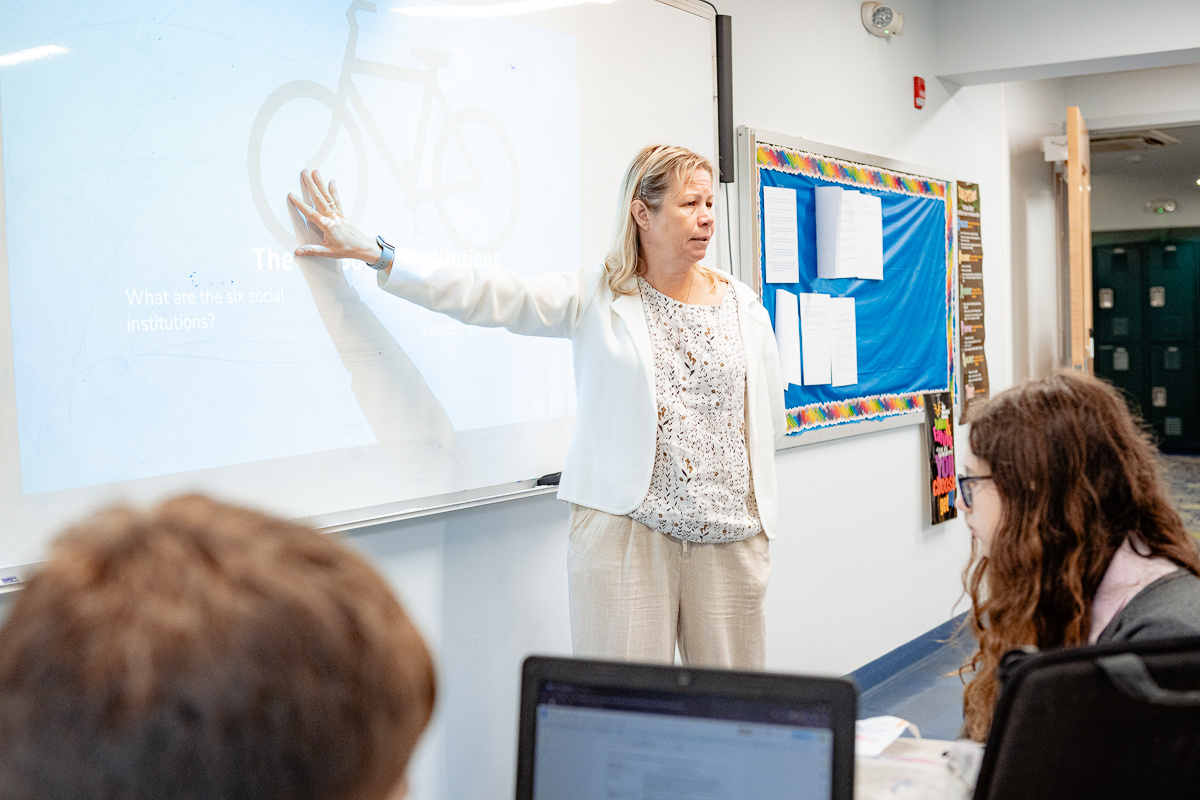
In Kathleen Schalk’s 7th Grade English class, the connection between a bicycle and the formation of the Iroquois nation, also known as the Haudenosaunee and originally based in New York, was not necessarily a straightforward path.
“In what way is society like a bicycle?” asked Ms. Schalk of her students. Deconstructing its parts, they first began to consider the importance of each component in relation to the whole and then worked in small groups to assign six social institutions to a corresponding bicycle part. "The economy is like the wheels. It keeps a society moving forward," offered one student. Another student connected the frame of a bicycle to the institution of family and labeled it as most important.
With their matrix in hand, Ms. Schalk directed the class to dive into their summer reading, Peacemaker by Joseph Bruchac, to find textual evidence for the six institutions of society – government, social order, family, religion, education, and economy.

Bruchac’s historical fiction, which opens with the kidnapping of a young village boy by rival warriors, tells the story of how the Iroquois overcame generations of war to achieve unity and ultimately, The Great Law of Peace.
“How do they overcome conflict to find peace?” posed Ms. Schalk. “There lies an inherent integrity in going against what is accepted because you know what is right,” she added. “When those five nations united, it became a well functioning society; one whose government served as a model for the American constitution. America’s founding fathers met with Iroquois clan leaders and visited counsel meetings, as it was a living government on which they could base a new type of democracy.”
As students grappled with locating similar institutions within the Iroquois structure and culture, they began to uncover a deeper meaning. “Storytelling was the Iroquois’ version of education,” pointed out a student. “And their economy looked very different from our society today as they used natural resources to create products to sustain their society,” suggested another classmate.

In the final part of the unit, students returned to the larger group to argue which social construct was the most important. “Eventually, they realized that no one part is more important than the other for society to succeed,” shared Ms. Schalk. Students finished with a brief, but collaborative, analysis of the positive influences the Iroquois still have today and how they remain relevant.
Were the Iroquois a successful society by today’s standards? “Even though it looked very different, students agreed that the Haudenosaunee society was successful,” shared Ms. Schalk, adding that the Iroquois’ Great Law of Peace served as a foundation for the U.S. Constitution. 
A realignment in disciplines and summer curriculum work paved the way for this new lens. “Last year, the History department moved away from world cultures to American history,” explained Ms. Schalk. “So, the essential question for English became ‘How do we recognize and honor the voice of those who have been silenced in American history?’ ”

Throughout the lesson, students were asked to consider “how do you find the truth within a creation story, a myth, or a fictionalized account?” The key, Ms. Schalk reveals, is to always look for values across history, and across culture. “Due to the stereotypes that existed about Indigenous peoples, coupled with the oral tradition of the Haudenosaunee, it wasn’t until the early 1900s that the Iroquois were given credit for their cultural and societal contributions.”
An upcoming 7th grade field trip to the Museum of the Native American Indian will add the last layer of context to this new unit. Throughout the unit of study, a Quaker lens is applied. “Stewardship was an intrinsic part of their belief system, and peaceful resolution of conflict the primary focus of the story,” Ms Schalk explained. “In recognizing the Iroquois as a living culture, we are able to see an equality of peoples and not a culture that is less than just because it is different.”
Photography by Alvin Caal/Friends Academy
Download Premium
Lorem ipsum dolor sit amet, consectetur adipiscing elit, sed do eiusmod tempor incididunt ut labore et dolore magna aliqua.

About the Author