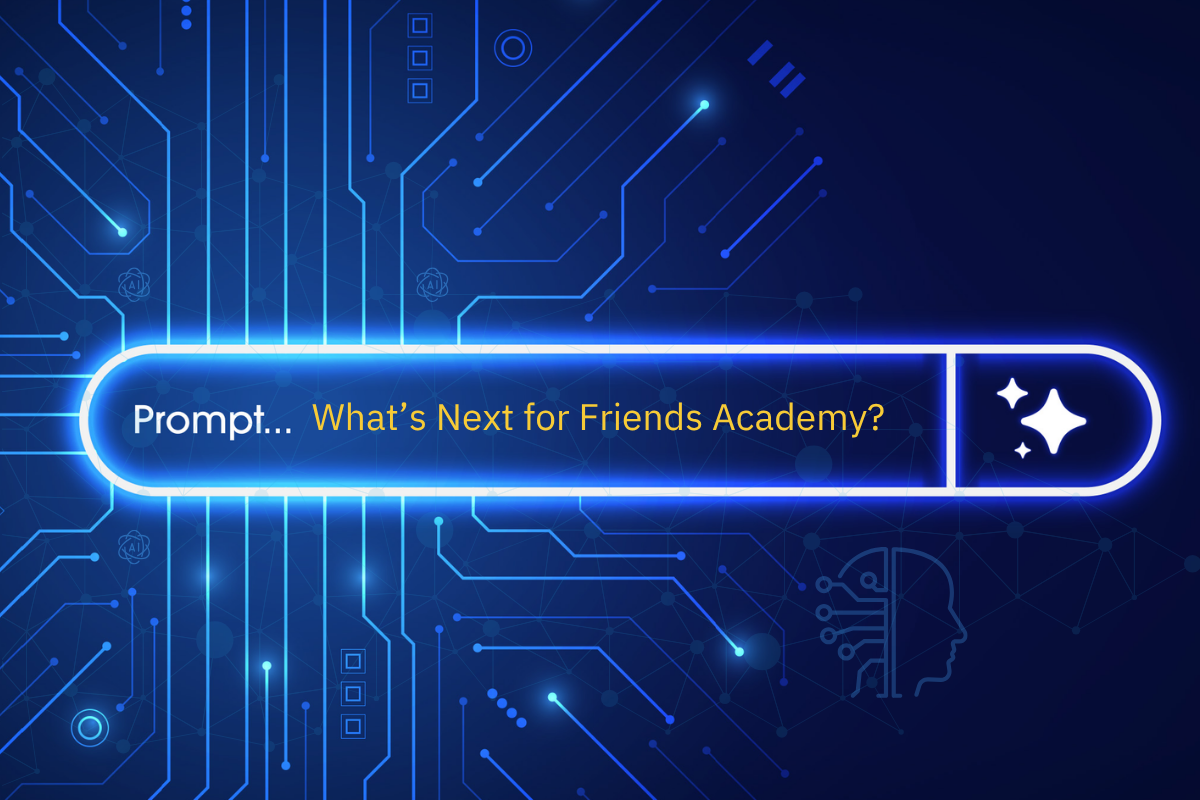
This feature was originally published in the Spring 2026 issue of The Meeting House, the magazine that chronicles the classrooms, community, and campus life at Friends Academy. The story explores the school’s policy on AI and how teachers and students are adapting to the emerging technology.
* * * * *
It’s a Wednesday afternoon in mid-September 2025, that time of year when a slight chill begins to grip the air and students start digging into the new school year in earnest: first tests, first presentations, first deep forays into new discoveries and untapped ways of thinking.
At first glance, the 11th grade American Literature class taught by Mr. Daniel Mendel looks to be the quintessential classroom belonging to the Chair of the English Department. The names of famous authors are written on white boards and discussed in conversation: Ralph Ellison, Toni Morrison, Ismael Reed, William Faulkner, E.B. White; more literary giants to come in the days and weeks ahead.
But Mr. Mendel isn’t just an English teacher at Friends Academy. He’s also the Dean of Innovation. In this role, he’s spent nearly the past year leading the process to architect the school’s new, forward-thinking policy on artificial intelligence — which he’s now putting into practice.
In a corner classroom on the second floor of the Kumar Wang Library, American Lit is being taught in new ways for the first time in the school’s 149-year history.
Or anywhere else for that matter.
The first assignment — Beyond the Algorithm: The Human Element in Literary Research — puts students at the intersection of tradition and modern technology. They’re required to use AI as a first point of contact when researching the lives and works of American authors.
“It starts out with just them and a blinking cursor,” Mr. Mendel says.
In previous years, juniors would have been staring at a different blinking cursor as they crafted analytical paragraphs — precisely the kind of outdated assignment that can now be bypassed in the blink of an eye with artificial intelligence.
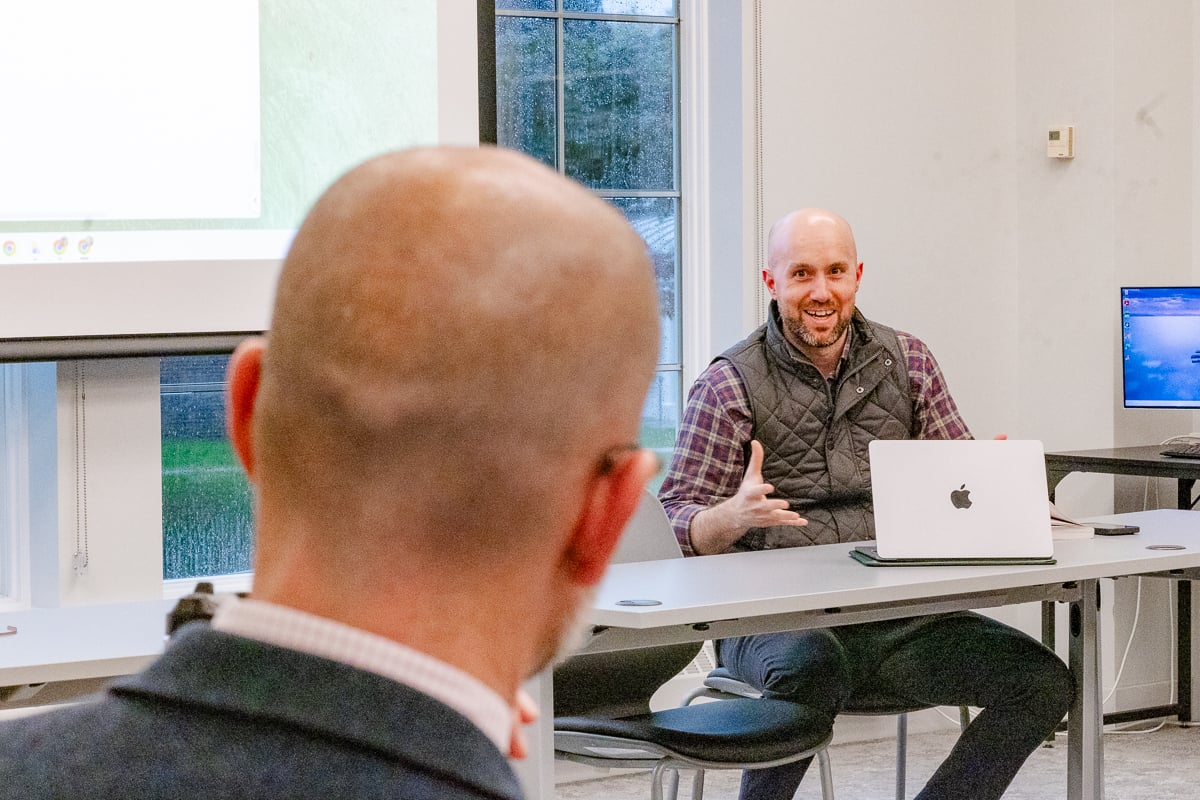
“Our school has a great tradition, but we can’t keep doing the same things we’ve always done,” says Mr. Mendel (pictured below). “Do they need to learn how to write a paragraph? Absolutely. But if that’s all we were doing, some would have run that assignment through AI and submitted it as their own. They would have found a way around doing the thing we thought they needed to do before AI upended it. “Beyond that,” he emphasizes, “these students are capable of doing so much more than mere paragraphs.”
At the beginning of the 2025-26 school year, students chose their author by selecting a literary quote that called out to them from a collection that had been printed and spread out on tables. Soon after, they began interacting with Gemini, the AI platform built by Google, about the nature of those quotes and the authors who penned them.
Their starting point of inquiry: What initial information did AI provide? What seemed to be missing or oversimplified? A bridge to deeper understanding: Fill in research gaps by consuming interviews, essays, original works, and scholarly reviews.
On this particular Wednesday afternoon, students begin presenting their findings — not just about their authors, but also about their research methods and how AI either helped or hindered the process.
“It’s our job to equip students so they’ll walk into the world as good, moral leaders,” Mr. Mendel says. “English class has always built foundational human values. By integrating AI, we are giving students what is timeless and also meeting them with what is timely. “We need to prepare them to have different skills and talents to succeed in the future,” he adds. “Otherwise they might get eclipsed by other people who are trained to navigate this really complicated technology.”
* * * * *
If you happen to be confused about artificial intelligence — the upsides, the pitfalls, how it all works — you’re not alone. It’s a fast-growing, far-reaching technology that has been labeled in mainstream media as both the death and future of education.
The paradox goes something like this: Students who use AI won’t learn for themselves. Students who aren’t using AI will fall behind those who know how to use it to their advantage.
Ahead of the 2025-26 school year, Friends Academy rolled out an AI policy to clarify how students and teachers can ethically engage with the technology. The policy, listed on page 44 of the Student & Parent Handbook, features a helpful use-case chart that has been replicated below.
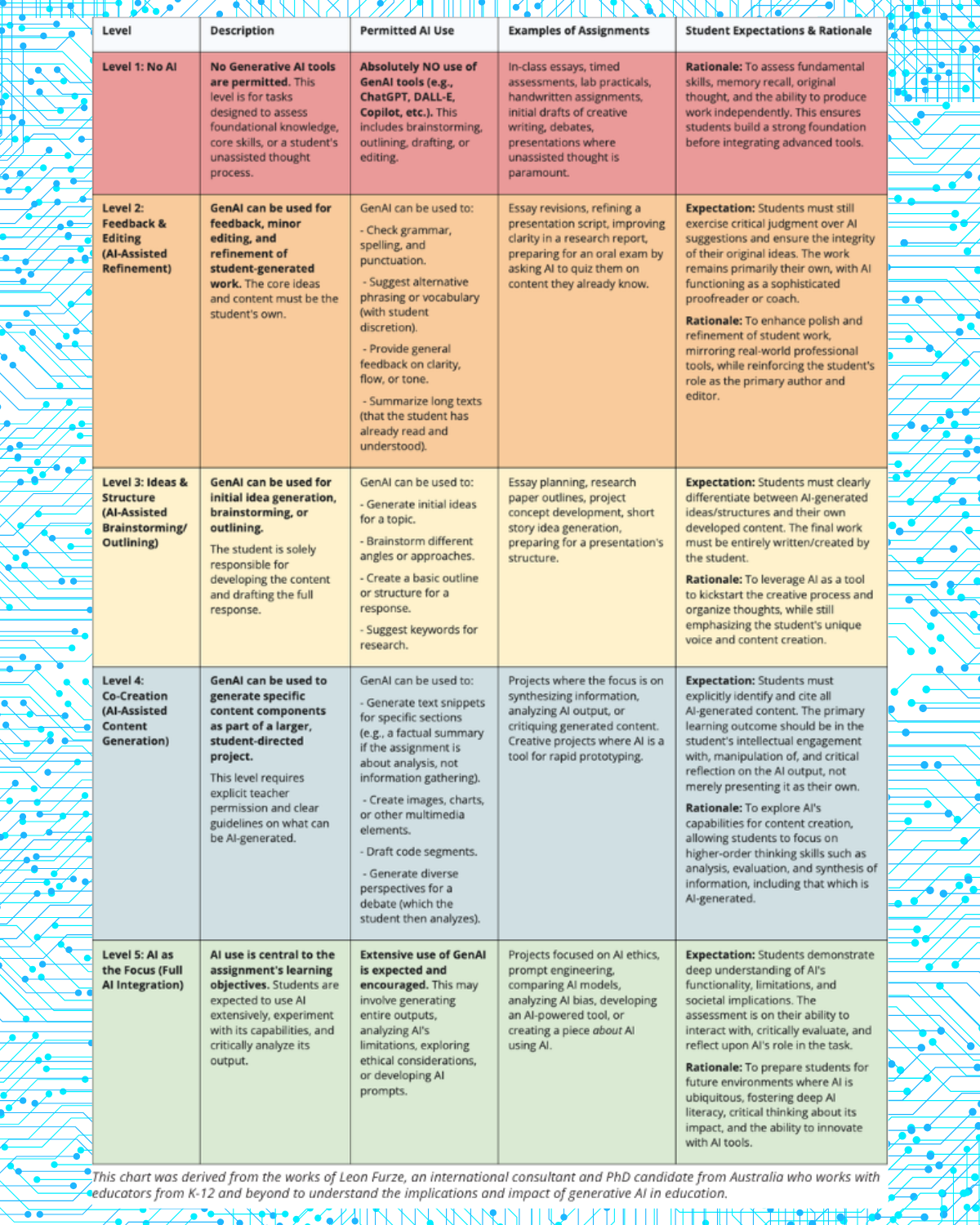
Clerked by Mr. Mendel and Mr. Ken Ambach, the school’s Director of Technology, the AI policy was designed with input from Upper School students and teachers from all divisions of Friends Academy. The most essential framework, Mr. Ambach says, is understanding that “AI literacy is a part of digital literacy. From the earliest computer classes that students can take at Friends Academy, we’re talking to them about what is real and what is fake, what is true and what isn’t. The throughline is having the discernment to know the difference.”
The AI policy is centered on the Quaker philosophy of Continuing Revelation, the idea that beliefs shouldn’t be permanently fixed and that new insights can lead to deeper understanding. The policy’s purpose statement speaks to the heart of this: “Proactive engagement with AI, rather than avoidance, is essential for developing the intellectual and ethical growth of each student.”
There are three main pillars of the AI policy:
-
The first is authentic inquiry: AI should not replace but rather support critical thinking and personal inquiry.
-
The second is integrity: All submitted works must reflect a student’s own learning and understanding, with AI assistance properly acknowledged.
-
The third is discernment: Students are expected to understand when and how AI can be a valuable tool, and when it is inappropriate or counterproductive.
In the Upper School, students have school-sponsored access to two AI platforms created by Google: Gemini (for grades 9 through 12) and NotebookLM (for juniors and seniors). Because Friends Academy pays for academic licenses, all information entered into these tools by students and teachers is “blackboxed,” meaning Google doesn’t use it to train algorithms for the world at large.
Students do not need explicit directives or permission from teachers to use the technology, nor are they prohibited from using other AI platforms (Chat GPT, Gauth, etc.) beyond the school’s Google offerings.
In conversations with The Meeting House over the first half of the new school year, students across all grades of the Upper School explained how they’re interacting with AI.
Anecdotally, they say it’s been most helpful explaining processes in math and science. When students find themselves stuck doing chemistry homework, for instance, they don’t have to wait to ask a teacher for help. Instead, they can turn to AI as a tutor in the moment and follow step-by-step instructions on how to break down problems. Students say AI has been a valuable resource for turning study notes into practice tests and for adapting notes to different learning styles. Notebook LM, for instance, turns written content into podcast form.
Students even deployed AI while vacationing during winter break. One used it while traveling abroad to translate languages and communicate with strangers. Another, stymied by a faulty golf cart battery, uploaded a video taken in the moment and received instructions on how to solve the problem (and it worked).
There are known drawbacks to AI, of course, which students say they are learning to navigate through trial and error. While AI can help brainstorm ideas or explain the scope of topics in the humanities, students have experienced AI’s propensity to “hallucinate” or make things up when it comes to deeper research. A common refrain students shared: Always check AI’s sources and make sure AI didn’t hallucinate fake sources.
Beyond AI’s definable plusses and minuses, there’s a large gray area for students.
* * * * *

Some students who shared their experiences for this story (without being directly quoted) wonder if they might be relying on AI more than they should — or maybe not. They aren’t sure, even with the school’s new policy to lean on.
Their confusion highlights a pain point throughout education at large.
Let’s follow the progression over time.
There was a time before the internet when conducting research meant pulling countless books off library shelves. But as the internet flourished, the shelves became something of a relic. New research in every field was published online, and this rising digital tide cited and surfaced older research, making more expert information more widely available than ever.
Despite the technological leap, the internet turned out to be similar to working with books. Students still had to consider the veracity of sources, and they had to engage with multiple works to understand a topic’s scope before making connections and explaining the essential takeaways in their own voice.
And then AI entered the chat.
More than just the latest disruptor, the technology obliterates traditional ways of gathering information and synthesizing it into knowledge.
Let’s pause for a moment to check-in.
If you understand how AI obliterates traditional methods, you’re likely engaging with AI on a semi-regular basis. If that statement doesn’t resonate, this brief exercise may help.
Enter the following query into Google: “What makes dragonflies effective hunters?” Your assignment: Research the best sources and submit both a robust summary paragraph and a comprehensive list of bullet-points highlighting all key components.
If you’re short on time, of course, everything you need to know can be found at the top of that Google search in the AI overview section.
How powerful is the technology?
AI processes information faster than humans; it considers a wider scope than humans; it organizes and points to its sources; it delivers results with digestible, retainable clarity. Alumni technologists interviewed as expert sources for this story posit that AI’s “hallucinations” will become fewer and fewer in the coming years, meaning more and more people around the world will turn to the technology as a trusted source.
Which means AI poses far more than just a paradox for students; it also poses existential questions about the future of schools.
How should Friends Academy adapt when the paradigm is shifting so rapidly from traditional ways (school is about what students know and how they garner knowledge) to unchartered territories (what are students capable of doing with expert-level info that everyone can instantly access via artificial intelligence)?
“Our school is a place that has always coached up and produced exceptional students,” says Mr. Scott Hertrick, who has grappled in recent years with how AI is influencing students in his AP Research class. “If we keep teaching them to do stuff that can now be easily replicated by a machine instantly, I don’t know that we’re giving them the tools to still be exceptional.
“We need to find the differentiators that will keep setting our students apart,” he adds. “How do we reach for a higher ceiling when so much more is on the table for everyone immediately?”
* * * * *
Whether it’s dragonflies or any other topic, students know they can’t copy and paste what AI produces and turn it in as their own — that’s a clear red line — but there are still gray areas to navigate.
How much of an AI overview must students change to make it their own? What is the difference between paraphrasing AI overviews versus primary sources? What are the best ways to distinguish ownership of ideas in the age of AI? When do facts need specific attribution? When can they just be restated as widely known facts?
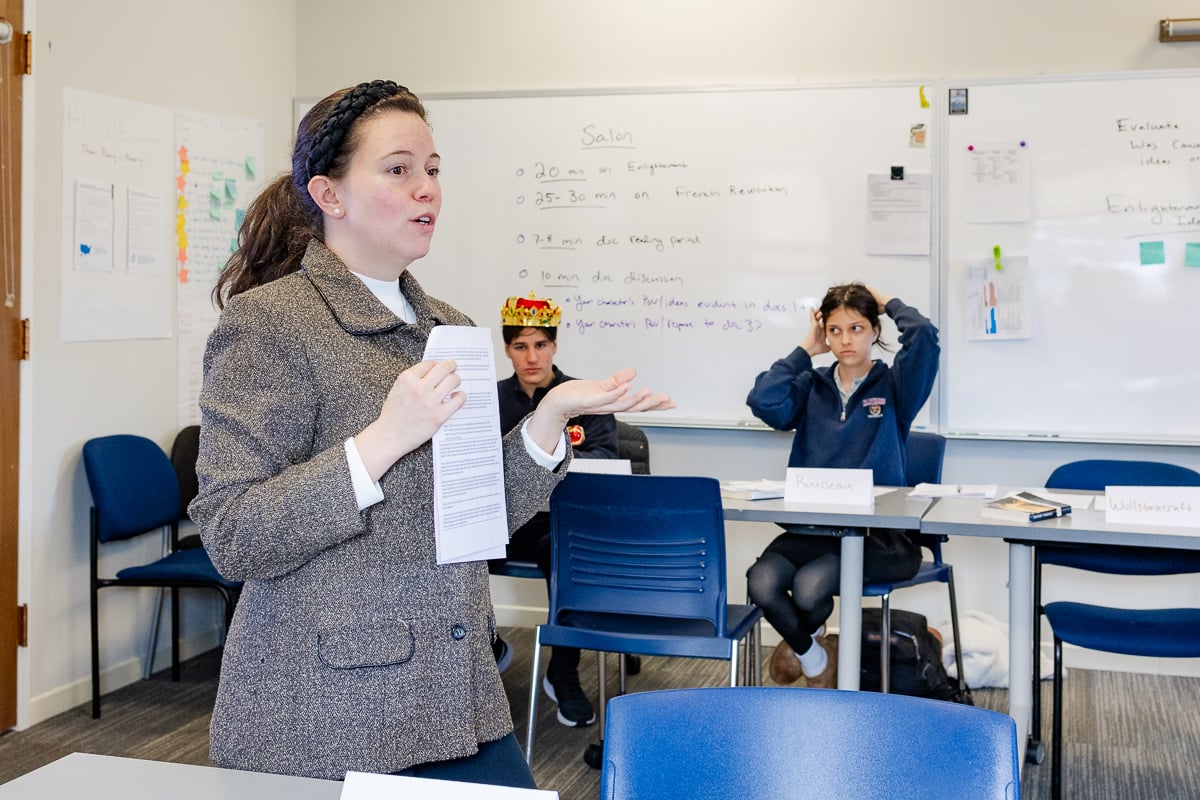
Students aren’t the only ones feeling disoriented in AI’s new wilderness. This winter, many of the same concerns led Ms. Amy Delaney, the Chair of the Upper School History Department (pictured above), to change her syllabus in 10th grade AP European History for the first time in her seven years at Friends Academy.
Given the time constraints of the semester and the new realities of AI, she dropped a research paper requirement. “I didn’t think anyone was going to cheat,” she says. “AI is just so prevalent that it’s hard for them to navigate and detangle. I had to choose where we put our focus.”
The crux of Ms. Delaney’s lesson remained the same. Students assumed the identity of historical figures — Hobbes, Voltaire, Kant, Locke, Catherine the Great, and others — and debated in salon format that person’s point of view on the French Revolution (even if that person wasn’t alive to witness it) and how their historical figure would view many of the enduring issues in modern times.
The sourcing requirements were robust. Students created a Salon Discussion Prep Sheet and had to cite their primary sources (three to four) and secondary sources (two to three) in MLA format.
“This class is operating in a traditional system, the AP model,” Ms. Delaney says. “We can’t afford to spend too much time doing a research paper and digging into all of the AI concerns when we need the time to prepare for the AP test, which maybe doesn’t work as well anymore with the new realities of this technology.”
Ms. Delaney still assigns research papers in other non-AP classes, where she helps students navigate AI as she finds her own way forward. “Teachers didn’t have this technology when we were in school and I wasn’t trained in how to teach students to use AI,” she says. “But it’s a reality we have to deal with.
“I think most students want to learn how to use AI in ways that are beneficial,” she adds. “But at the end of the semester, with grades lingering in their minds, I think there’s also that temptation to lean on it too much — to do the heavy lifting in a way that’s not helpful.”
Students were not quick to open up about the gray areas of AI for this story, even with assurances that they wouldn’t be named or quoted, but none held back when describing their schedules.
They’re busy. They feel pressure. They’re prioritizing their time, energy, and focus between schoolwork, sports, clubs, afterschool activities, service projects, and all the hobbies that make them interesting, well-rounded people. AI, they say, helps them be more efficient. To the extent they’re using the technology — is it too much sometimes? — students say it’s hard to have deep conversations with teachers when they don’t know if any given teacher might be a purist (books only), a realist (the internet is a modern library) or a pioneer (AI is a frontier to explore and be tamed)?
To be sure, calling AI a frontier is something of a misnomer because it no longer exists on the fringe of everyday life. “The latest tipping point for AI,” Mr. Hertick says, “is that you no longer have to seek it out — it’s now seeking you out. It’s in our emails, in our Google Drive folders, at the top of our internet searches. It feels inescapable.”
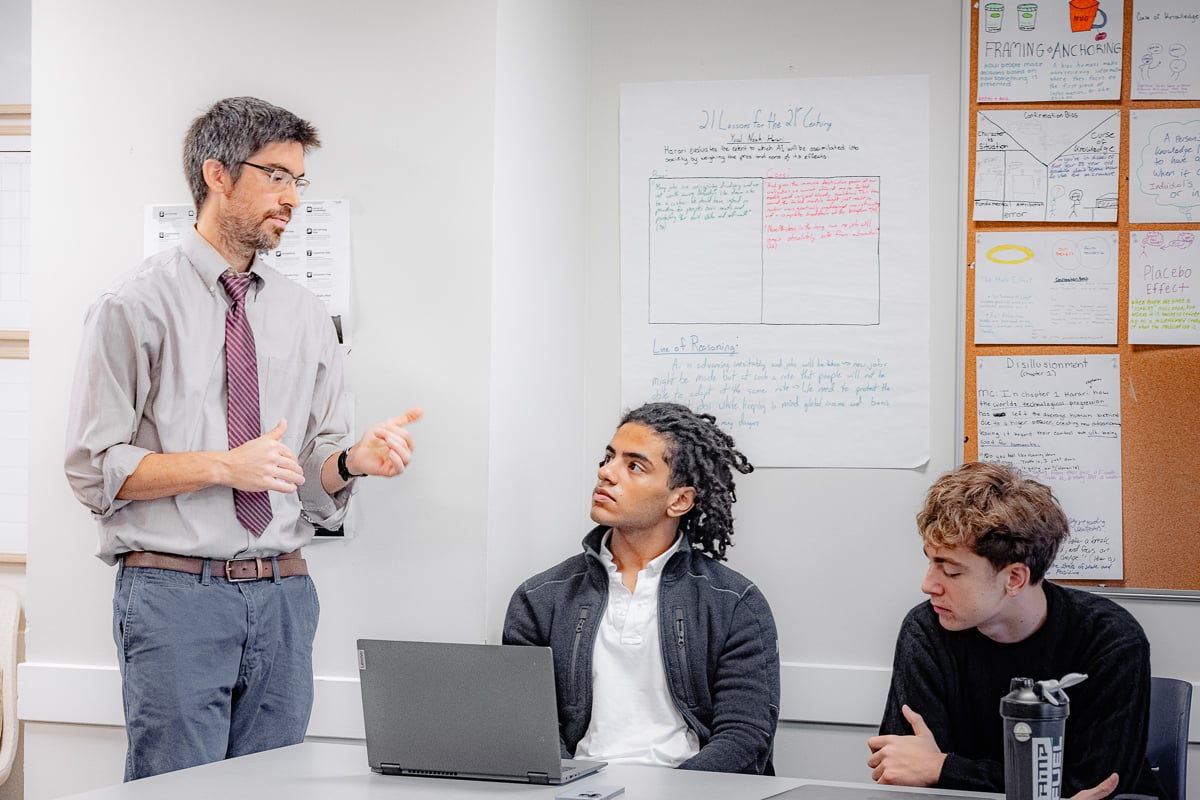
In AP Research, Mr. Hertrick (pictured above) has a checklist of what students should consider in their methodologies of discovery: a source’s credibility, bias, slant, perspective, and expertise. Students should also know how each source relates or connects to other sources, and they should understand how each source has shaped their own understanding of a topic. Instead of students relaying their understanding with written paragraphs, Mr. Hertrick now has them share thoughts in one-on-one conversations with him or draw mindmaps in sketchpads.
“Can you draw something that synthesizes and makes sense of the relationships and connections and spectrums of opinions between different sources?” he says. “I’m assuming you can read an article and understand the core concepts. Rather than proving that by writing a summary, can you represent your thinking by showing it?”
Mr. Hertrick believes students are embracing these new ways of learning, but he also senses a subtext to the larger AI conversation — the loud unspoken part separating teachers and students. If an assignment hasn’t been changed to work with or around AI, students can’t help but wonder: What’s the point of doing it if AI can do the same thing faster?
“I’m helping students build the skills they need to engage with ideas,” Mr. Hertrick says. “The challenge is to find work that is meaningful and feels personally significant for them. AI is forcing us to all reconsider what it means to teach and to learn in a way that is genuine, deep, and authentic.”
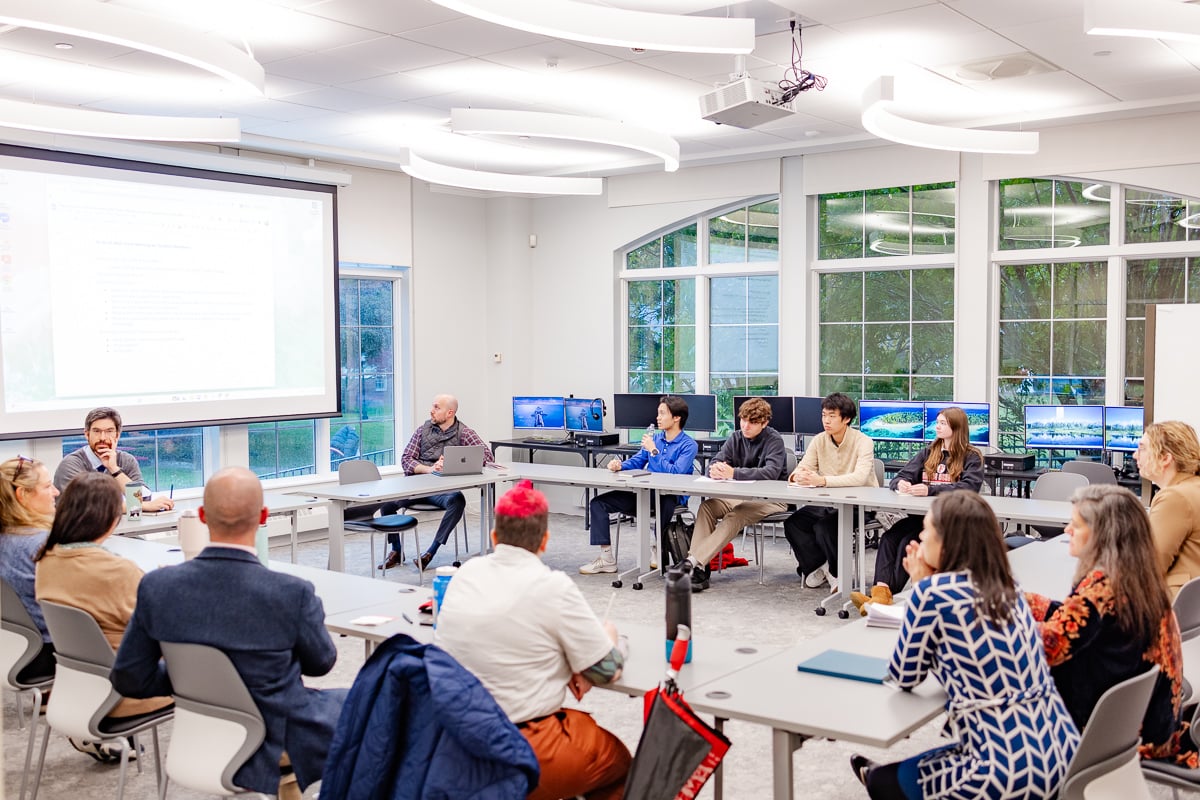
With the idea of removing teacher-student power dynamics and engaging in honest dialogue, Mr. Mendel and Mr. Ambach regularly convene an AI Research & Development team to assess how the AI policy is working in practice.
Composed of Upper School students and faculty, this group reviews their experiences, compiles use-case studies, and considers blind spots when it comes to the technology. In these R&D spaces, students are encouraged to share their own AI experiences (or how their friends are using it) without fear of judgment.
“We want students to be part of the decision-making and part of the thinking,” Mr. Ambach says. “They’re sharing their experiences and they’ve been incredibly honest about it. They’ve expressed their anxiety about AI — what’s interesting is that their anxiety is much different than the anxiety that teachers have about AI.
“The students aren’t intimidated or scared by the technology,” he adds. “For them, it’s not a question of whether or not they should use it. They’re worried that it’s going to get them in trouble or affect their college applications. They’re worried about the systems that the adults are running and whether those systems will allow them to use AI tools the way they want to.”
* * * * *
When students in Mr. Mendel’s 11th grade American Literature class presented their findings in mid-September, they had the freedom to deliver their reports in any style: a short speech, a one-page visual aid, a pre-recorded video, a mixture of multimedia — anything but a traditional paper that could have been written by AI.
“The format can be up to you as long as it effectively communicates your journey of discovery,” Mr. Mendel told students. “Your presentation is not a report. It is a demonstration of your unique investigation. You will not simply state facts, but instead, reveal how your understanding evolved.”
Final instructions: Share why you chose the quote. Share a research twist. Demonstrate how a source beyond AI shifted your perspective.
One student chose a quote by Faulkner — “Art has no concern with peace and contentment” — because he found it to be confusing and wanted clarity.
It wasn’t easy to come by.
After finishing his research, the quote still created confusion at home, with the student’s mom expressing a different interpretation the night before the assignment was due. That last-minute impasse prompted the student to seek out Mr. Mendel the next morning before class.
As a result of their conversation, the student amended his presentation to share that “sometimes people will have different understandings of the same thing, which means AI can be wrong. We have to make decisions with the most evidence — and just because someone tells you that you’re wrong, it doesn’t mean you’re wrong.”
Traditional education models have always zeroed in on the distinction between getting the answer right or wrong. By incorporating AI into the English classroom, Mr. Mendel introduced a new matrix to assess students.
“I have feedback for everyone in this class about their public speaking, presentation skills, research techniques, and collaboration with the teacher,” he says. “These are all things that will make them better and more equipped to succeed in life.”
Because we can’t yet fully grasp how AI will shape the future, those human skills could prove to be more vital than ever.
“Our students are the future architects, implementers, and decision-makers in this space. Because this technology potentially has no ceiling, it’s our job to provide the compass. Our job as educators is to prepare them to live meaningful lives and lead the world.”
A Friends Academy alum who graduated in 1998, Matthew Monahan has worked with AI throughout his technology career, which includes a stop with IBM’s Watson Health. Mr. Monahan’s advice to students: pay close attention to AI advancements in the coming years; consider how they might impact your college, major, and career. His most pointed question: If certain fields use AI to replace entry-level jobs, then what will the path look like to become a senior person in those fields?
“There are a lot of implications,” he says, “but the reality is we don’t have most of the answers yet.”
As Mr. Mendel puts it, “People who were alive when the automobile was invented, they couldn’t have known all the ways that it would change society. They probably had reasonable guesses and a sense of the technology’s ceiling. I could end up eating my words, but I think there’s potentially no ceiling on how AI could change society.”
Mr. Mendel imagines such a future, in part, because AI can self-improve and make technological leaps without human intervention.
“Once an automobile is built, it requires a human to alter it,” he says. “We don’t know what AI technology is eventually going to do and how it’s going to change our world.”
As much as Mr. Mendel has immersed himself in the world of AI, it’s hardly his sole focus. After completing that AI assignment, his American Lit class read John Steinbeck’s 1962 book, Travels With Charley in Search of America. Students penciled notes in the margins of paperback versions and discussed the novel in roundtable discussions.
“The world is increasingly becoming digitized and isolated,” Mr. Mendel says. “We engaged in discussion-based learning with a book, which is an analog technology, and shared our thoughts and opinions face-to-face. Knowing how to use AI is a valuable skill, but so is learning how to talk with people, establish relationships, disagree constructively, and wait patiently to share your point of view.”
Like parallel lines converging in the distance, Mr. Mendel makes little distinction between his two roles as English Chair and the Dean of Innovation. For students and colleagues alike, he hopes to model balance instead of a tug-of-war between modern technology and traditional ways of academia.
“If you’re always preaching one versus the other, you’re limiting everyone’s sense of possibility,” he says. “I care deeply about simplicity. I look for tech-free zones in my life and in my teaching. I also believe in putting groundbreaking technology in young people’s hands and not depriving them of what’s available in the world.
“It’s the contrast that makes things resonate and pop,” he adds. “In order to understand something deeply, you have to experience the opposite of it too.”
* * * * *
At home, Mr. Mendel’s daughters, Naomi, 4, and Amelia, 7, engage with AI in ways meant to fuel creativity.
Their dad uploads photos of them with their stuffed animals — a penguin and a monkey — and turns everyone into characters in coloring-book format. The kids color the print outs, continually adding pages to the fictional adventure story of their childhood.
Mr. Mendel’s family also dabbles with Suno, an AI platform that turns text prompts, humming or lyrics into songs — vocals and instrumentation included. They turned one acapella song that Naomi made about mac-and-cheese and laid it over tracks, turning it into a bopper that has been shared with and played more than 300 times by people in their extended family.
Which lands us back squarely in the paradox of AI: How will she truly learn music if she’s relying on AI to do it for her?
“Right,” says Mr. Mendel. “I’d never want her to learn about music from only an app. She also takes music lessons with a teacher. It’s the combination of the two things — the traditional and the innovative — that allows her to grow in ways that she otherwise wouldn’t in the absence of one of those tools.”
Even with its upsides, AI has been widely criticized for giving humanity so-called “AI slop,” which Google’s AI defines as “the overwhelming flood of low-quality, often inaccurate, AI-generated digital content (text, images, video, audio) that lacks human creativity, effort, or meaning.”
To be clear, The Meeting House isn’t calling Naomi’s mac-and-cheese masterpiece AI slop. (Far from it, you little rockstar!) But the basic idea raises one of the most pertinent questions of our time: If anyone, anywhere, can endlessly create AI-generated content, what does it mean for art?
In the end, that which is timeless is always timely.
To borrow from Faulkner: Perhaps it is AI that ultimately has no concern with peace and contentment.
“AI could have more concern about peace and contentment if we lead in the right way and shape it in the right way,” Mr. Mendel says. “Nobody is wishing for the disruptiveness of AI. It’s not like teachers and educators are collaborating with AI companies, which have their foot on the gas.
“Our students are the future architects, implementers, and decision-makers in this space. Because this technology potentially has no ceiling, it’s our job to provide the compass. We must equip them to use AI ethically, morally, and wisely in ways that are good for humanity. That’s our job as educators: to prepare them to live meaningful lives and lead the world.”
Photos by Alvin Caal / Friends Academy
Download Premium
Lorem ipsum dolor sit amet, consectetur adipiscing elit, sed do eiusmod tempor incididunt ut labore et dolore magna aliqua.